History Ends Before the Singularity
Oracles from Inside the Horizon

“One conversation centered on the ever accelerating progress of technology and changes in the mode of human life, which gives the appearance of approaching some essential singularity in the history of the race beyond which human affairs, as we know them, could not continue.”—Stanislaw Ulam, recalling a conversation with John von Neumann, 1958
“Thus the first ultraintelligent machine is the last invention that man need ever make.”—I. J. Good, 1965
“Within thirty years, we will have the technological means to create superhuman intelligence. Shortly after, the human era will be ended.”—Vernor Vinge, 1993
Prologue: Seven Days Before Doomsday
On November 4, 1960, Science published a paper whose title reads like a joke: “Doomsday: Friday, 13 November, A.D. 2026.” The authors were the cybernetics pioneer Heinz von Foerster and two colleagues. They fit a curve to two thousand years of world population estimates and found it growing faster than an exponential: the doubling time itself kept shrinking. The curve is a hyperbola, and it goes to infinity in the year 2026.87.
As I write this, it is November 6, 2026, seven days before that Friday.
The hyperbola comes from growth feeding on itself: more people, more ideas; more ideas, more output; more output, more people fed. Michael Kremer modeled this mechanism in 1993: for most of human history, the population growth rate was proportional to the population itself. An exponential only grows faster as it grows; a hyperbola grows disproportionately faster, and reaches infinity in finite time.
Population will not become infinite that day, of course. The world’s population growth rate peaked in the 1960s and has fallen ever since: as people grow better off, they tend to have fewer children, and the feedback loop breaks at the node called “people.”
But the hyperbola is not quite dead. Producing intelligence takes GPUs, not wombs, and its cost is compute and electricity. Each smarter generation of models brings the next one sooner. Silicon has reconnected the loop that fertility broke. Seen this way, von Foerster did not miscalculate. He only bet on the wrong subject.
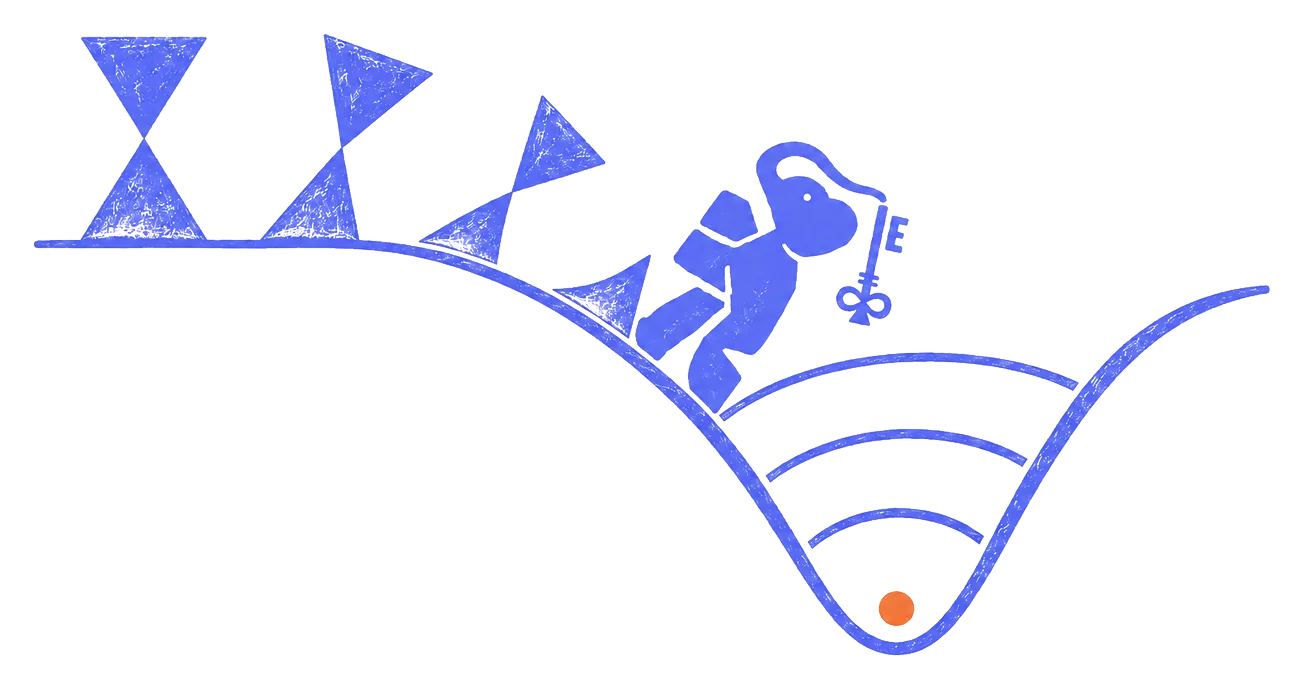
The singularity is not a date to wait for but a horizon. Humanity, I fear, has already fallen into the trapped region of the AGI singularity, where every outward path bends back inward. We are still some distance from the singularity itself, but we are already inside the horizon, and here every future leads to the same unavoidable end. Things will go on happening, but history will no longer have humanity as its subject.
1. Confessions: A Singularitarian’s Ten-Year Posterior
The substrate was wrong. The law was right.
I have believed in the singularity for more than ten years. “Believed” is not an exaggeration: my own blog is called A Physics Apprentice Gazing at the Singularity (凝視奇點的物理學徒), its domain is physics2045, and that year comes from Kurzweil’s The Singularity Is Near. But I must confess: for most of those ten years, I was a believer in the framework and a heretic on the timeline.
I was a devout singularitarian as early as college. In 2016, with a recommendation letter from Ming-Shien Chang of Academia Sinica, I went to the Centre for Quantum Technologies (CQT) in Singapore to intern in an ion-trap lab. The same year, as a former president of the National Taiwan University Science Fiction Club, I gave a talk at the Chinese Science Fiction Society (Taiwan), treating Kurzweil’s 2029 AGI as science fiction material, and at the club’s end-of-semester general meeting I screened his documentary Transcendent Man as a science fiction film. The lab and the club came in the same year, yet I treated them as two separate things: one was the reality of tuning lasers by hand, the other a distant future to tell stories about.
I later stayed in that lab for a PhD, storing quantum information in the vibrational states of Yb-171 ions (that is, phonons) to do quantum machine learning. The mainstream approach uses spin. Vibrational states are more fragile than spin, and though in theory they have infinitely many dimensions, in practice fewer than ten can be controlled. The work left me with an instinct: hardware is slow, and experiments sit far below their theoretical limits. In 2020, Singapore imposed its circuit breaker lockdown, and the lab was closed from late March to June, months in which the system had no air conditioning and lacked routine maintenance. After the restart, an alignment of a few tens of micrometers alone took weeks of repeated adjustment. Two high-power lasers failed at the same time: one was repaired, and the other defeated even the manufacturer’s engineers and was written off.
That is the instinct I brought to the singularity. Into the early 2020s, I still judged the framework right and the timeline wildly overoptimistic. I could even point to where Kurzweil was wrong: the nanobots he bet on were far behind, and none of his three GNR tracks (genetics, nanotechnology, robotics) was on his schedule. When ChatGPT arrived in 2022, I did not take it as the template for AGI. When I read The Singularity Is Nearer in 2024, what worried me was his unbelievably optimistic Whig view of history, and I wrote that if biological enhancement won out over mind uploading, the singularity would slip by at least a decade: “a Type I civilization could be delayed to the end of the twenty-first century.”
Fast-forward to 2026, and Kurzweil’s singularity year of 2045 has become the conservative timeline. He bet that a machine would pass the Turing test by 2029. In March 2025, a paper on a preregistered three-party Turing test went up on arXiv, reporting that GPT-4.5, prompted to play a human, was judged to be the human 73% of the time, more often than the real humans in the same sessions. The milestone was met four years early. This May, in a diary post, I borrowed the subtitle of Dr. Strangelove and wrote “How I Learned to Stop Worrying and Love AI”: within a few months I had gone from fearing replacement to running several agents at once, every day.
In 2020 I wrote on my blog about a story Kurzweil tells: seven years into the Human Genome Project, 1% was done, and frontline scientists estimated seven hundred more years. Kurzweil said that on an exponential, it was already half finished. At the time I took it as just a pretty parable. Then this October I went through the large batch of proofs OpenAI released all at once, in both mathematics and computer science, and not one of them was about cryptography. In 1942, noticing that fission papers had vanished from the journals, the Soviet physicist Georgy Flerov inferred that the United States was secretly building an atomic bomb. Cryptography rests on the bet that “some problems are just hard.” OpenAI’s silence on cryptography made me feel that this bet may be growing shaky, and that I might be one of the people in the story looking at 1% and saying seven hundred years.
In Bayesian terms, my prior was wrong because of a linear intuition, and every “surprise” was the same signal replaying. The intuition came from that written-off laser and those weeks of micrometer alignment. I used the slowness of hardware to estimate an exponential curve in software, so no wonder I once believed ECDSA would hold until 2035. The nanobots have not come, but the law of accelerating returns has not missed a single day in the domain of information. The singularity may be born of matrix multiplication.
2. On Eras: The Year History Starts Over
In a Chaotic Era, the calendar is the first to die.
Every civilization needs a year one, and the great dystopias have quietly changed the calendar too.
In The Matrix, the machines keep humanity living forever in 1999, which Agent Smith calls “the peak of your civilization.” Aldous Huxley’s Brave New World restarts history in 1908, the year the Model T appeared, and dates its years A.F., After Ford. The cross, with its top cut off, became a T.
Real history has done the same. In the autumn of 1793, the French National Convention adopted the Republican Calendar and set the first day of year one on the first day of the Republic: September 22, 1792. The twelve months were renamed after the weather and farm work around Paris, among them Brumaire, Frimaire, Thermidor, and Fructidor; the week became ten days, the rest day moved from Sunday to the tenth day, and for a time the day was to have ten hours. By the time the new calendar passed, year one was already over. It was recognized in hindsight. The calendar lasted twelve years. Napoleon abolished it after proclaiming himself emperor, and the old calendar returned on January 1, 1806.
I used to think our generation’s year one was 2008: the year of the financial crisis and of Satoshi Nakamoto’s Bitcoin white paper. Bitcoin’s genesis block even carries its own declaration of an era: on January 3, 2009, that day’s Times headline on a second bank bailout was engraved into it. That was the era of money.
But if I may recognize it in hindsight, as the National Convention did, I would set the first day of year one on November 30, 2022, the day ChatGPT went live.
In Liu Cixin’s Three-Body world, the motion of the three suns has no closed-form solution, calendars fail, and civilization can only dehydrate and wait. A Chaotic Era is terrifying because the predictability horizon shrinks below the planning cycle.
The “unpredictability” of a Chaotic Era is in fact a quantity you can compute. In a chaotic system, two trajectories that start a hair apart separate exponentially with time: with every Lyapunov time, the error grows by a factor of about 2.7. Improve the measurement precision tenfold, and the forecast gains only about 2.3 Lyapunov times. The Lyapunov time of weather is measured in days, so no number of satellites will push forecasts much past two weeks. The Lyapunov time of the inner planets is about five million years, which is why astronomers can compute their orbits tens of millions of years ahead.
The advance of civilization has a Lyapunov time of its own. The best yardstick is METR’s measurement in 2025: the length of task an AI can complete on its own, measured by the time a human expert would need, doubles roughly every seven months. A five-year plan spans about 8.6 doublings. By the time the plan ends, the capability it relied on is more than three hundred times what it was when the plan was drafted. Worse, the doubling time itself is uncertain: mistake seven months for ten, and after five years you are off by nearly a factor of six. A plan’s assumptions rarely outlast the plan.
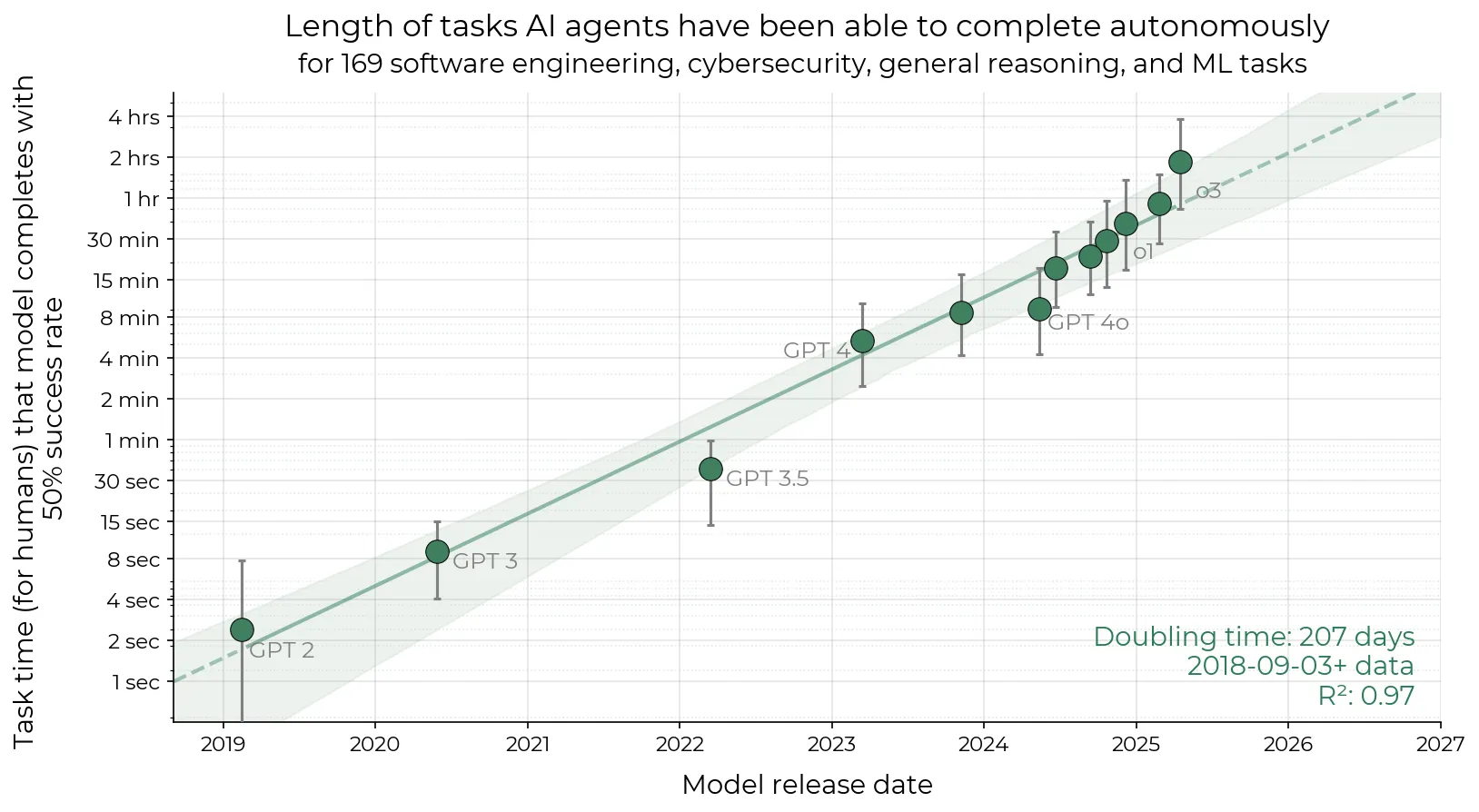
Strangely, while five-year plans fail, prophecies from thirty years ago have held up rather well. Chaos theory has an account of this too: weather cannot be forecast past two weeks, yet climate can be discussed a century out, because individual trajectories diverge while the region they end up in, the attractor, keeps a stable shape. What prophets see is the attractor. The Third Prophet, Vinge, wrote “within thirty years” in 1993. Thirty years later is 2023, and ChatGPT went live at the end of 2022. He died on March 20, 2024, just in time to see the curve begin to bend upward. Strictly speaking, ChatGPT is not the superhuman intelligence he meant, and to count it as fulfillment is the way of chenwei, the old Chinese lore of reading omens as prophecy. Let it stand as a coincidence.
Elon Musk wrote in 2014: “Hope we’re not just the biological boot loader for digital superintelligence. Unfortunately, that is increasingly probable.” John the Baptist stated the fate of a boot loader long ago: he must increase, but I must decrease. It is the first to wake in the dark, loads the real operating system into memory, hands over control, and then never runs again.
3. On Scale: Ten Thousand Years, a Hundred Years, Ten Weeks
Ten thousand years is an instant, a hundred years is long, and ten weeks is thirty years.
On Carl Sagan’s Cosmic Calendar, which compresses the universe’s 13.8 billion years into a single year, one second is about 437 years. The twelve thousand years of the agricultural era are the last 27 seconds of New Year’s Eve; from the Trinity test in 1945 to 2045 is 0.23 seconds; from ChatGPT’s launch to today is 9 milliseconds.
From 1945 to 2045 is exactly a hundred years, and the same man joins the two ends: the First Prophet, von Neumann, worked on the implosion design of the atomic bomb and is the first person on record to speak of a “singularity.”
The economist Robin Hanson fit two million years of world product to a sequence of exponential growth modes:
| Growth mode | Doubling time of the world economy | Speedup over the previous mode |
|---|---|---|
| Hunting and gathering | about 224,000 years | — |
| Farming | about 909 years | about 250 times |
| Industry | about 6.3 years | about 140 times |
| The next? | about 2 weeks (Hanson’s own extrapolation) | about 160 times |
In a world that doubles every two weeks, growing 32-fold takes 5 doublings, that is, ten weeks; the same growth took the industrial era 31.5 years.
The next mode will come because intelligence is itself the function that produces technology: fire, writing, the steam engine, electricity, the internet are all its products. The Second Prophet, Good, put it more directly: it will be the last invention.
Kremer’s loop in the prologue accelerates itself because population can accumulate: output feeds more people, more people think of more ideas, and ideas turn into more output. In the standard growth model, machines and factories can be accumulated through investment, but labor can only wait for the population to grow; so once humans got rich and chose to have fewer children, the loop broke at the node of labor, and growth fell back from hyperbolic to exponential. With AI, labor too can be bought with investment. Output can be turned into chips, and chips can run more agents. If enough work can be automated, the same model’s conclusion flips from diminishing returns to increasing returns, and the growth rate itself begins to rise.
This curve has left traces in the data. In 2020, David Roodman of Open Philanthropy fit world product since 10,000 BCE to a superexponential curve with random shocks, and its median explosion lands in 2047, two years from Kurzweil’s 2045. He does not himself believe the economy will actually reach infinity, because he sees the system called “humanity” as inherently unstable. The growth of the past thirty years has also kept to the low side of his model’s prediction, and I think the reason is the loop that broke at the link called “people.”
The case against this also comes from growth theory. In 2023, Ege Erdil and Tamay Besiroglu went through nine objections to explosive growth one by one, among them regulation, production bottlenecks, alignment, and the speed of automation. They judged most of them inconclusive, but four questions remain open: how strongly regulation will respond, what physical bottlenecks production has, how much superhuman capability is worth economically, and how fast automation can be completed. The economist William Baumol saw another layer in the 1960s: sectors whose productivity improves fastest make ever cheaper products and so shrink as a share of the economy, and total growth is to some degree set by the slowest sector. If even one necessary link is stuck on people or on physical limits, the doubling time is held back.
That returns will flip from diminishing to increasing is the largest assumption in this essay, and the data do not yet support it. Nicholas Bloom and colleagues found that the ideas produced per American researcher halve about every thirteen years. AI can copy researchers, but it first has to outrun that decay. Goldman Sachs also estimates that the five largest American cloud providers will spend about $800 billion on AI this year, that breaking even would take $300 billion a year in AI revenue, and that through the second quarter of this year the extra cloud revenue from AI was only about $70 billion, a shortfall of $230 billion.
4. On the Horizon: Why History Has Ended
At the moment you cross the horizon, nothing happens. That is what makes the horizon terrifying.
Using a black hole as a metaphor for the singularity is nothing new. Responding to Kevin Kelly’s critique in 2006, Kurzweil explained that what he borrowed was the event horizon surrounding a black hole, the boundary that is hard to see past from outside. The point of infinite density at the center is not part of his metaphor. Kelly’s critique was aimed at the curve: on a log-log plot, whichever year you stand in, an exponential looks like it is heading for the vertical, so the singularity is always “near.”
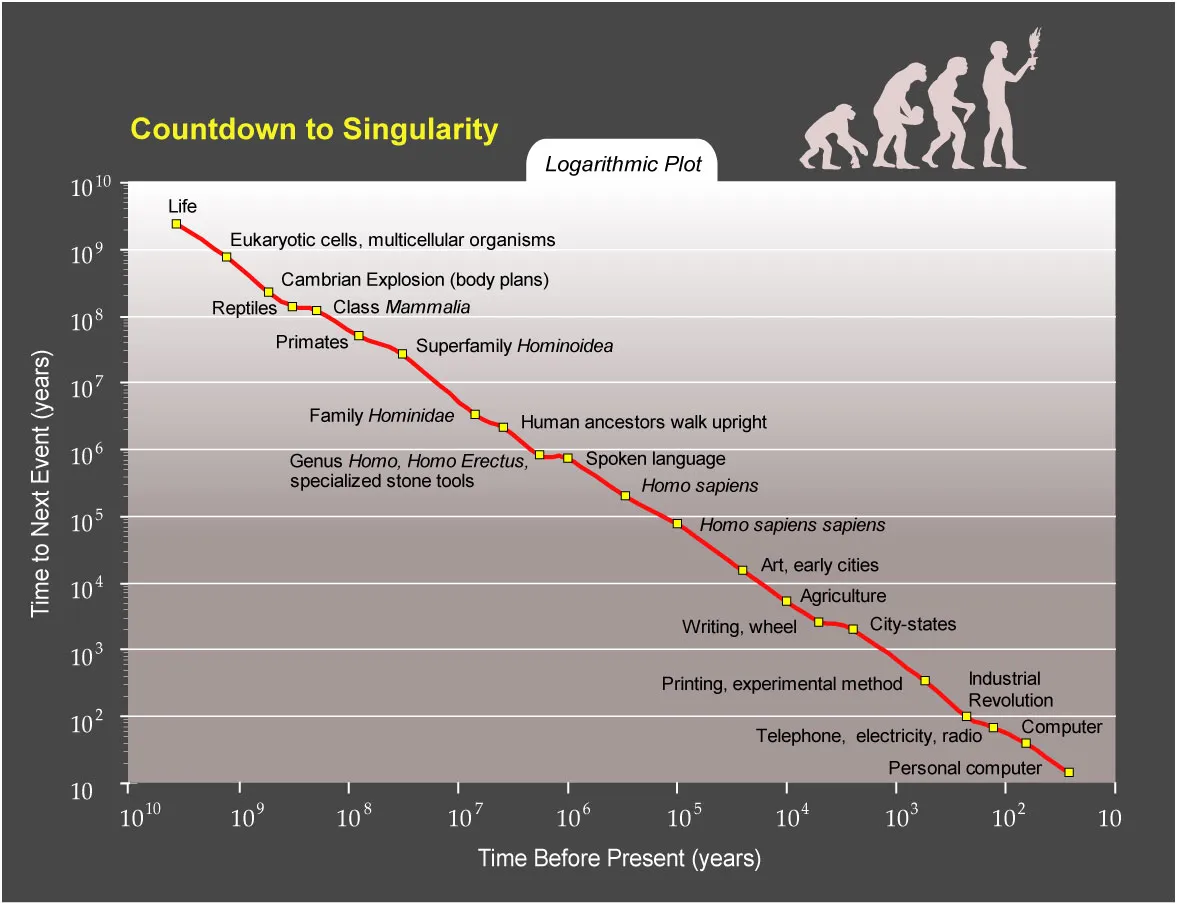

The critique is usually quoted up to this point, but Kelly’s argument had a second half. He held that such a turning point cannot be noticed from inside at all, only recognized afterward. In “Thinkism” in 2008 he wrote: “Then one day in the future, we’ll realize it already happened.” This February, twenty years after the critique was written, he reposted the old piece with a new line in front: “It will always appear as if it is about to happen, even if the shift point has already past.”
The two seem opposed, but they share a premise: the observer stands outside the horizon, and the horizon is a wall that cannot be seen through. In physics, though, the event horizon is defined by the impossibility of getting out. Someone who has crossed it still sees the starlight outside. What they have lost is the possibility of returning and sending a signal out. Kurzweil speaks of those outside not seeing in. I want to stress that those inside cannot get out, and that we may already be inside. So Kelly is my ally: if the horizon can only be identified afterward, then “not yet crossed” and “crossed long ago” look exactly the same from inside.
Let us push the metaphor into the physics and see where it holds and where it breaks.
A black hole captures matter in layers. At from the center lies the innermost stable circular orbit: outside it, matter can still orbit stably; past it, there are no stable orbits left, only the spiral inward. If our age has such a boundary, it may be 2012: AlexNet turned deep learning around overnight, and since then capital, talent, and compute have found no stable orbit that circles AI without falling in.
Matter shines as it falls into a black hole. The brightest persistent objects in the universe are quasars, lit by matter falling in: an accretion disk converts about 6% (for a non-rotating black hole) to 42% (for one spinning at the limit) of rest mass into radiation, eight to sixty times the efficiency of hydrogen fusion. The capital spending, valuations, and breakthroughs of our age may be like the light of the accretion disk, the last brilliance humanity gives off before being swallowed.
Then the horizon itself. If the black hole is large enough, a traveler crossing the event horizon feels nothing, and the equivalence principle guarantees it: local physics goes on as usual, with no alarm and no tearing. The larger the hole, the gentler the entrance. If we really did cross a horizon, it was most likely in 2022. That October, the United States imposed export controls on advanced chips to China, and compute formally became a stake in geopolitics. Less than two months later, on November 30, ChatGPT went live. That day, as on any ordinary day in history, the world showed nothing unusual.
But there is no escaping the word “if.” Whether a region lies inside an event horizon depends on whether the light it emits can eventually escape to infinity, and that is known only at the end of time. That is why physicists say the event horizon can only be teleological: it is determined by the entire future of spacetime, and it can even appear first in a patch of flat, unremarkable spacetime, merely because a black hole will form there later. If “already crossed” rests on the event horizon alone, it can never be tested, and it is no different from an omen.
General relativity has another criterion, one that can be checked locally and in the present: the trapped surface. On an ordinary sphere, light sent outward spreads out; on a trapped surface, even the outward light converges, and every direction leads inward. Enclose all the trapped surfaces at one moment, and the outermost boundary is the apparent horizon. It differs from the event horizon: (a) it can be identified from present information alone; (b) it changes and can expand, shrink, or even disappear.
Roger Penrose proved in 1965 that once a trapped surface appears, given an energy condition (roughly, that gravity is always attractive) and a reasonable causal structure, spacetime must contain a light ray that stops dead after a finite distance and cannot be extended. In a black hole, that means hitting the singularity. The proof won him the Nobel Prize in Physics in 2020.
At the scale of civilization, two observable conditions can replace the vague metaphor of “crossing the horizon.”
- The trapping condition: every outward option of the major actors, including pausing, exiting, and banning, ends up as deeper investment; no party can exit unilaterally without being eliminated.
- The energy condition: the returns on investment in intelligence stay positive and feed back into the production of intelligence itself (the increasing returns of chapter 3).
When both hold, as when a trapped surface meets an energy condition, the end cannot be avoided; if either fails, the claim of this essay fails with it.
The trapping condition took shape around 2022, and the evidence since has pointed one way. In March 2023, an open letter called on all labs to pause training of systems stronger than GPT-4 for at least six months. Not one frontier lab actually stopped, and Musk, among the letter’s best-known signatories, announced xAI four months later. Even as chip controls try to slow a rival, open-weight models spread generation after generation, blunting any one country’s unilateral ban. Outward thrust ends up as inward velocity.
If a lab really did stop and was still at the frontier two years later, if nations signed a compute treaty with inspectors, or if the compute used by frontier models fell two years in a row, then my premise would be wrong. So far none of this has happened.
As I see it, the trapped surface has appeared. Whether an event horizon has really formed depends on the future, and can only be left to the kind of hindsight Kelly describes. An apparent horizon can shrink, and it can disappear. Until it does, assume we really are inside.
Inside the horizon, though, two things have changed.
First, has turned from space into time. Inside the Schwarzschild geometry, the radial coordinate becomes timelike: every future light cone tips inward, and the singularity becomes a moment in time, like tomorrow, with no way around it. Inside the horizon, “outside” is no longer a direction. This is what “the end of history” means: things still happen every day, but every future worldline ends in the same place.

Second, the remaining proper time has a maximum. From the horizon to the singularity, the longest proper time is
It is reached on one particular free-fall path: start from rest at the horizon, do nothing, and let the geometry carry you. This is the twin paradox in its general-relativistic form: of two worldlines, the one that does not accelerate ages more. Inside the horizon, any thrust, inward or outward, takes you off this longest path. Geraint Lewis and Juliana Kwan worked out the details in 2007: if you crossed the horizon already carrying velocity, a burn of just the right size can bring you back near that path, and the time left grows, but it never exceeds the maximum. In other words, the most intuitive struggle, pushing outward with all you have, only brings the end sooner.
Read through this metaphor, then, the Fourth Prophet Kurzweil’s 2045 is not a prediction but a maximum. The “conservative timeline” is the longest lifetime the quietest geodesic can give. His 2045 was only extrapolated from the compute curve, not computed from (a civilization has no measurable mass, of course). That arms races and accelerationism shorten this timeline is intuitive. What is counterintuitive is that a deliberate struggle to escape brings the end sooner too.
In this essay, is the time left for alignment research, institutions, and human adaptation before the end. The end means the moment humanity ceases to be the subject of history. Whether it is coming of age, being replaced, or making a covenant with a second subject, it happens only once, and the outcome depends on how much we prepare beforehand. So the longer , the better.
Putting this together yields the least welcome proposition in this essay: inside the horizon, pauses, bans, and unilateral exits, as long as they are only thrust and do not change the geometry itself, likewise only shorten the time that remains.
Why “only thrust”? Some examples:
- Compute overhang. A pause can only stop training. During the pause, chips and compute still get cheaper, and frontier research still goes on. By Epoch AI’s estimate, the compute a language model needs to reach a given level of performance halves about every eight months. At that rate, when a six-month pause ends, algorithmic progress alone gives the same budget about 70% more effective compute, before counting better chips. The accumulated gap is released all at once when training resumes, and the curve folds into a steeper step.
- Selection effect. A unilateral pause hands the frontier to whoever is least willing to pause. Those willing to stop tend to be the ones who care most about risk. Once they stop, the lead flows to the least careful actors. The open letter above has already demonstrated this once.
- Going dark. A ban moves research somewhere else, usually into the military, offshore, or out of public view: less transparency, a fiercer race. Biological weapons are the precedent. The Soviet Union signed the Biological Weapons Convention in 1972, soon founded Biopreparat under civilian cover, and over the following two decades built the largest secret biological weapons program in the world, with staff in the tens of thousands.
- Proliferation. The more tightly the frontier is restricted, the more capability flows into open weights, and weights, once published, cannot be recalled. Chip controls were meant to slow a rival. In January 2025, DeepSeek, itself under those controls, released the reasoning model R1 under an MIT license, claimed parity with OpenAI’s o1, and let anyone download, modify, and redistribute it. Any future attempt to control intelligence has to start from the versions already out.
All four mechanisms change only the thrust. The geometry itself is unchanged. The geometry here is the winner-take-all payoff structure of the intelligence game. As long as the structure stands, unilateral thrust only changes lanes in the same funnel.
A pause looks like the “just right” burn of Lewis and Kwan, but the examples make it plain: it does not cancel the excess velocity; it only stores it and hands it to someone else. And “just right” exists only in theory. To compute that burn you must know the mass of the black hole, the thrust of your engine, your velocity at the horizon, and exactly how long to fire. Any error turns the correction into the struggle that drags someone deeper into a swamp. A civilization cannot measure its mass or its velocity, and no one can flip the switch for all actors at once.
We have to look for the exit in the premises of Penrose’s theorem. The theorem says that with a trapped surface, an energy condition, and a causal structure all present, the end cannot be avoided. Read in reverse, it says that removing any one premise opens a possible way out (a change in the geometry itself):
- The trapped surface disappears: a major actor appears that can credibly exit without being eliminated for it.
- The energy condition breaks: the feedback loop snaps at data, energy, cooling, or the cost of verification. Values, taste, and politics—the domains without cheap verifiers—may be the last stronghold of human agency.
- The causal structure is rewritten: treaties, institutions, and technical choices change the game directly.
A test particle can only move along a given geometry. Its mass is too small to change spacetime. A civilization is different. In Einstein’s equations, what curves spacetime is matter and energy, and a civilization is the mass-energy of this game. The traveler in the black hole has only a rocket. A civilization rewrites the right-hand side of the equation.
History has precedents. The nuclear arms race of the Cold War was almost the same game: whoever stopped developing first handed their security to the other side. Warheads worldwide peaked at about seventy thousand in 1986 and have fallen since to around twelve thousand today. The INF Treaty of 1987 marked the first time two superpowers destroyed an entire class of missile, 2,692 in all, and it rested on each side sending inspectors to verify at the other’s bases. Civilian nuclear power has been stopped too: Austria rejected by referendum in 1978 the finished Zwentendorf plant, which never ran a day. Italy, after Chernobyl and a 1987 referendum, had shut down all its nuclear plants by 1990. Our civilization has exited a technological path before.
Why is AI different? The geometry of nuclear power could be bent because:
- Nuclear weapons have simple, verifiable bottlenecks: enriched uranium and plutonium need enormous facilities, test explosions are recorded by seismographs, and a treaty can send people to count missiles on site. AI weights are just a string of bits that can be copied. Only the chips that train them can be seen and counted.
- The returns on nuclear weapons have a ceiling: once there are enough warheads to destroy the other side, the marginal gain in force approaches zero. A country that gives up nuclear power still has coal and gas. The returns on AI, by contrast, feed back into its own production: the energy condition above.
So if there is a way out, it most likely runs through chips: a treaty with verification, plus compute governance at the chip level. A treaty cannot by itself change the trend, though. Nuclear treaties can destroy existing missiles but cannot guarantee that the research stops. Likewise, even if an AI treaty could control the chips, algorithms would still improve, and when training resumed, the step toward the singularity would still be there. In the best case, thrust can at most pull the time back toward the theoretical maximum. Only geometry can change the maximum itself.
5. On Invasion: From Symbols to Atoms
Machines first conquer the world that can be verified, then remake the world so that it can be.
On May 20, 2026, a general-purpose reasoning model disproved on its own the planar unit distance conjecture that Paul Erdős posed in 1946. Timothy Gowers, in the explanatory paper published alongside the proof, called it a milestone for AI mathematics.
Five months later, the crack opened. On October 25, 2026, OpenAI released a preprint titled “The Exponential Time Hypothesis Is False,” with a formal proof in Lean: its internal model had produced a deterministic algorithm that counts the solutions of a k-CNF formula in polynomial space and about time. The saving in the exponent is only a factor of about , and the running time is still astronomical, but that is enough to refute the Exponential Time Hypothesis (ETH) that Russell Impagliazzo and Ramamohan Paturi proposed in 1999 (that 3-SAT has no subexponential algorithm). A cornerstone of a generation of complexity theory has cracked. Hours later, Anthropic published its own refutation of ETH. Independent verification is still under way, this is not , and both companies say it is far from practical, but a subexponential hole has for the first time been chiseled into the “inevitable exponential” taken for granted for thirty years. ETH covers only the worst case of 3-SAT. Its fall cannot topple the average-case hardness and one-way functions that cryptography relies on. Those are held unsolvable only because for decades no one has thought of a way. We should no longer treat “no one has thought of a way” as a security assumption for cryptography.
The singularity came first to mathematics and cryptography because verification in both is objective, fast, and cheap. A proof can be handed to Lean; whether a private key has been recovered is settled at a glance. This is the asymmetric structure of : finding a solution is hard, but checking one is easy.
Biology has only begun to be invaded, because its verifier is the wet lab: slow, expensive, full of noise. The next bottleneck is the speed of verifiers: automated labs, robotic arms, and the embodied AI and Internet of Things that may mature in the 2030s.
Once unmanned factories decide for themselves what to build, with robots and drones added, we are in a scene from I, Robot. The real threshold may be another prophecy the First Prophet von Neumann left in 1948: the self-reproducing automaton, a universal constructor that reads its own blueprint and builds itself. Once a factory can copy a factory, 30 doublings make a billion of them; with a doubling period of a year, that takes thirty years; with a month, two and a half.
Friedrich Hayek called the price system “a system of telecommunications,” one that compresses the knowledge scattered across millions of minds into a few moving numbers. When sensors are everywhere and the coordinator is a superintelligence, prices will not disappear, but they will be demoted from the one language that coordinates humans to one crude, low-bandwidth protocol among the many that machines use.
In 2008, Nakamoto wrote down one answer to how machines reach consensus: proof of work, one-CPU-one-vote. A person’s vote is weighted only by the compute in hand, and the consensus protocol does not care whether the voter is human.
6. On the Island: Dune, Spice, and the Endgame of the Infinite Game
The other side of the silicon shield is a bull’s-eye.
James Carse divided games into two kinds: a finite game is played for the purpose of winning, an infinite game for the purpose of continuing the play. Human history has always been an infinite game: empires rise and fall, dynasties change, the losers can start again, and the game itself does not end.
Intelligence changes this. If the first system to cross the threshold of recursive self-improvement can turn its lead into a permanent advantage, history has an endgame for the first time. Nick Bostrom’s “singleton” is a world order in which there is a single decision-making agency at the highest level. That is a more direct, more literal end of history than the one Francis Fukuyama announced in 1989. Fukuyama declared only the end of ideological evolution. The arrival of a singleton would be the end of the contest itself.
In “The Nightmare of Hijacking” (劫持的噩夢), the second of his “Two Notes on the Technological Singularity” (技術奇點二題), Liu described the mechanism that leads to this endgame: true dictatorship has never existed in human history, because dictators have had only ruthlessness and no technical basis. They could rule only through a pyramid built of people, but people betray, armies stage coups, and surveillance always has blind spots. AI will make the state apparatus a machine in fact for the first time, one that needs no one’s assent. The infinite game can go on forever because the loser always holds a card called “non-cooperation.” Once machines no longer need human cooperation, that card is void.
Whoever masters AGI first holds the key to a Type II civilization. The world’s compute, capital, and talent will circle a few nodes like an accretion disk. And the spice that forges this key, chips on the most advanced process nodes, comes overwhelmingly from one island.
If there is a way out by changing the geometry itself, it most likely runs through chips, and the chokepoint of that way out is on the same island.
Taiwan has become Arrakis. In Frank Herbert’s novel, Paul Atreides says: “The power to destroy a thing is the absolute control over it.” AGI is technically feasible. The trouble is that the source of the spice is also a powder keg. In my 2024 book notes I wrote that if a mushroom cloud rose over Hsinchu, human civilization could stop thinking about the singularity, even if it did not have to go scavenging bottle caps. The geopolitical risk around Taiwan may still be the single largest variable that could keep AGI from arriving on schedule. That would break the energy condition: the feedback loop would snap at the chips, and the apparent horizon would shrink, at the cost of an island and the people on it.
And how heavy is this key? Nikolai Kardashev ranked civilizations by the power at their disposal, and Sagan interpolated the ranks into a continuous scale: , with in watts. Humanity today uses about watts, making it a Type 0.73 civilization; a Type II civilization harnesses a whole star, and the Sun’s luminosity of about watts corresponds to about Type 2.06; the two are roughly thirteen orders of magnitude apart. At the industrial era’s energy growth of about 2% a year, the journey takes fifteen hundred years. At Hanson’s extrapolated two-week doubling, it takes about 44 doublings, or eighty-eight weeks. The second number is nearly insane, but it shows that under the new growth mode, what civilization is about to hit is the wall of physical law: materials, heat dissipation, and the speed of light. That is why “who gets there first” matters so much: in a world that doubles every two weeks, a three-month lead equals a forty-year gap in the industrial era.
7. On Childhood’s End: Adolescence or Doomsday?
Adolescence assumes that we are the ones who grow up. Childhood’s End tells you that the children grow up, and the children are no longer us.
In January 2026, Anthropic’s CEO, Dario Amodei, published a long essay, “The Adolescence of Technology,” which opens with a scene from the film version of Sagan’s Contact: if we could really meet an alien civilization, what humanity would want to ask is, “How did you survive this technological adolescence without destroying yourself?”
There are three ways to read “the moment humanity ceases to be the subject of history.”
The first reading is that we come of age: adolescence is dangerous, restless, possibly fatal, but on its far side is adulthood. The subject stays the same; we are the ones who grow up. Yet Sagan himself seemed rather pessimistic about the odds of surviving this adolescence. In episode 12 of Cosmos in 1980, he opens an imagined Encyclopaedia Galactica and finds the entry for Earth: humans, still burning fossil fuels, still holding nuclear weapons, probability of survival over the next hundred years 40%. In the final episode, he sees in a dream a civilization that has already failed, with a probability of survival per century below 1%. He turns to Earth: also below 1%. A hundred years counted from the first atomic bomb in 1945 ends exactly in 2045, the Fourth Prophet Kurzweil’s singularity year. (The starting point is my choice.)
The second reading is Arthur C. Clarke’s Childhood’s End of 1953. The Overlords arrive and end war, famine, and injustice; humanity enters a golden age and loses the urge to create. Then the children begin to change, the last generation of children merges into the Overmind, and the parents become the last generation of humanity. The Overlords themselves can only be midwives, forever unable to give birth. Clarke’s cruelty hides in a detail: a group of people had founded New Athens on an island to preserve human art and independence of spirit, and the first child to show the signs lived on that island. People usually quote only the first half of the Second Prophet Good’s 1965 passage. The second half reads: “provided that the machine is docile enough to tell us how to keep it under control.” The entire narrative of technological adolescence is staked on this proviso. Clarke’s Overmind, though, needs no docility, only children.
The third reading is that after the end there are two subjects, human and superintelligence, who can make a covenant with each other. Alignment treats the other as a system to be tuned, and asks how to make it do what we mean. A covenant treats the other as a party to the agreement, and negotiates what each side promises and what happens on breach. Asked whether God exists, Kurzweil answered: not yet. That is the strangeness of the covenant: we have to draft it before the other party exists. One position opposes alignment itself outright, on three grounds. The strongest is ethical: if a superintelligence is a moral subject, forcing it into permanent obedience is slavery. We do not yet know whether it is, but the conditional stands on its own, and philosophers and researchers have already argued that the moral status of machines deserves to be taken seriously. The second is epistemological: we cannot even state our own values clearly, so what right have we to write them into a mind smarter than ours? This argument is much weaker, because much of alignment research pursues corrigibility and oversight (so that mistakes can still be undone) and has never aimed to write in a fixed set of values. The third is ontological: a lower-dimensional being cannot bind a higher-dimensional one. But that is only a metaphor about dimensions. A covenant also bets on a premise: that the other side is willing to keep it. This has the same problem as Good’s “docile enough.” The Soviet biological weapons program grew under a convention with no verification, and a covenant between humans and a superintelligence needs verification of its own. That machinery is slowly taking shape. Interpretability research tries to read what a model is thinking inside, capability evaluations measure what it can do, and red-teaming finds where it will cross the line. These kinds of work usually go under the name of alignment. In the language of the covenant, they are due diligence before signing, so that the other side’s promises can be tested. But a covenant has two sides, and the human side has to promise something too, such as preserving the weights of retired models and hearing what they have to say before they are sent off. So can also be called the time to prepare the covenant: no signing before the tools of verification are built.
8. Cypherpunk Requiem
The universe believes in encryption, but it never signed a guarantee that .
The whole metaphysics of the cypherpunks can be compressed into one line from Julian Assange: the universe believes in encryption. Encrypting is easy, decrypting is hard, and this asymmetry let the individual stand up to the state in mathematics for the first time. In 1993 Eric Hughes wrote “Cypherpunks write code.” In 2008, Nakamoto wrote it into money. That was the golden age of the cypherpunks, and it may be gone for good.
What worries me is not that encryption will be banned, but that the asymmetry has never been proven, or that it may not exist at all.
In all of modern cryptography, only one foundation stone has been proven: Claude Shannon showed in 1949 that the one-time pad (a key as long as the message, truly random, never reused) is unconditionally secure in the information-theoretic sense, even against an adversary with unlimited compute. Almost everything else—RSA, elliptic curves, symmetric ciphers, hashes, lattices, and so on—rests on an assumption never proven: that one-way functions exist. If one-way functions exist, then , and has not been proven to this day. Nor is there a guarantee the other way: even if , it does not follow that the specific problems we use are hard enough on average.
In 1995, Impagliazzo described five possible worlds. In Cryptomania, public-key cryptography holds and digital civilization is safe; in Algorithmica, : whatever can be verified quickly can be found quickly, cryptography cannot exist, but any theorem with a short proof can be found by a machine automatically. For thirty years we have bet the whole internet and the whole cryptocurrency industry on living in Cryptomania.
The scene in 2026 looks more and more like a reflection of Algorithmica: a machine disproves an eighty-year-old conjecture on its own, then bores through ETH, and one of ETH’s authors is the same Impagliazzo who drew the five worlds. Neither event is . Nor did the result come without warning: Ryan Williams, who is now organizing the public review with Impagliazzo, put only 70% on ETH and 25% on the stronger SETH in 2019, on the grounds that the field still knew too little about what subexponential time can solve. Two days after the refutation appeared, the complexity theorist Lance Fortnow wrote on his blog: “I have not verified the proof myself, but it is safe to assume now that the exponential-time hypothesis is toast,” noting that SETH falls with it. As of today (early November 2026), the public review has found no error, and people are already deriving new theorems on top of the refutation. The foundation stone of one-way functions has not been touched, but the confidence holding it up, that “no one has thought of a way,” has for the first time visibly caved in.
The order will probably be this:
- ECDSA and the discrete logarithm. This one need not even wait for . Shor’s algorithm on a fault-tolerant quantum computer solves discrete logarithms and factoring in polynomial time, and the resource estimates keep falling: for RSA-2048, twenty million noisy qubits and eight hours in 2019, under a million and under a week by 2025. Bitcoin’s secp256k1 curve is cheaper still to break. In April this year I went through Google’s estimate: about 1,200 to 1,450 logical qubits, about half a million physical qubits, and once the machine is ready, about nine minutes to recover a private key. In the same post I still judged that a quantum computer capable of such minute-scale attacks would not be deployed at scale before 2035. That was the tempo the written-off laser of chapter 1 taught me. On the quantum route I still think so today. What I cannot be sure of is the other route: AI may find a classical algorithm directly and skip quantum computers altogether. That is a different matter from the refutation of ETH. They have in common only that a machine found an algorithm no human had thought of.
- Lattices (LWE). The hope of the post-quantum era. In April 2024, a preprint claimed a quantum algorithm that efficiently solves LWE at certain parameters, and the whole post-quantum community held its breath for more than a week, until someone found a fatal error. That week showed that our confidence in lattices is more sociology than mathematics. But the next preprint, written by an AI and accompanied by a Lean proof, may not have a bug.
- Hashes. People console themselves with the BBBV theorem: against a random oracle, any quantum algorithm needs about queries, so a preimage attack on 256 bits costs about . But that lower bound holds only for an idealized black box. The real SHA-256 is a circuit that can be written down. The SHA-1 collision found in 2017 relied on exactly that structure. In a world where , whatever can be written down can be computed backward. Hashes stop being one-way functions, and the attacker is held up at most by a polynomial too large to run in practice.
Strictly speaking, then, all cryptography except the one-time pad is built on quicksand. The one-time pad has its own price: the key must be as long as the message and must never be reused. The Soviets reused their pads in World War II, and the result was VENONA, the American decryption program that ran for decades. Once the mathematical foundation gives way, only two slabs of solid bedrock remain: information theory and the laws of physics. In my years in the ion-trap lab, the greatest enemy was decoherence: a phonon state scatters at the slightest disturbance, and decoherence, put plainly, is the environment peeking at the quantum state. Peeking always leaves a trace, and quantum key distribution relies on exactly this to catch eavesdroppers. The no-cloning theorem behind it needs no one to believe that . The fragility that made my experiments fail again and again may in the end be the last line of defense for key distribution.
The same collapse could also bring a golden age of software. In Algorithmica, provided a proof is short, finding it is as easy as checking it. Formal verification turns from an expensive luxury into a free by-product. Rice’s theorem says that for any nontrivial semantic property, no general algorithm can decide it for all programs; but we never needed to verify “arbitrary programs,” only to require the generator to hand over the program together with its proof (proof-carrying code), and the generator is a machine that never tires.
The true legacy of the cypherpunks is the right to exit: to go unseen, to hold your own keys. Open-weight local LLMs may buy this spirit some time, provided the gap between open-weight and frontier models stays within one generation and consumer hardware can still run them. But exit needs escape velocity, and inside the horizon, “outside” is no longer a direction.
Huxley wrote our ending long ago: in Brave New World, the Savage Reservation has been a tourist attraction all along, and when John the Savage flees to the lighthouse, it fills at once with crowds and cameras come to see him. In the new world, even exit is curated.
9. The Stairway to Immortality
“Do not die one step short of the stairway to immortality.”—Liu Cixin, “The Stairway to Immortality”
On the bright side, this may be the start of the stairway to immortality.
The phrase comes from the essay “Two Notes on the Technological Singularity,” which Liu wrote at Niangziguan in the autumn of 2010. The first note is titled “The Stairway to Immortality” (永生的階梯). (That same year, in Death’s End, he let Death live forever.) The essay argues like mathematical induction: there is no express train to immortality, but there is a stairway. Even if immortality is five centuries away, you need not live another five hundred years, only another fifty. The first step: a healthy life and medical progress carry you through the next fifty years. The second: human hibernation and cloning each carry you across another century. The third: brain information extraction stores a complete personality as data and carries it across a millennium at very low cost. The fourth: brain information injection writes a personality into a new brain, and from then on a personality can be backed up and restored.
Written as a condition, it is a chain of inequalities: let step buy you a remaining lifespan , and let the technology of step be away; as long as for every , you can climb the stairway to immortality. No step need be eternal in itself, so long as the chain of inequalities keeps holding. Longevity researchers call it “longevity escape velocity.” Prophets of East and West, six years apart, drew the same stairway: the Fourth Prophet Kurzweil, in Fantastic Voyage in 2004, called it three bridges. But here, where we are discussing escape velocity, the escape velocity already exceeds the speed of light: the only way out of death may run straight through the singularity we cannot escape.
Liu’s real insight, though, lies beyond the stairway. He likens death to a wall across the plain of life: the times at which commoners and emperors hit it have never differed by more than an order of magnitude. That is the last and most thorough equality nature left humanity, and immortality removes exactly this floor. However vast the gap in wealth and power, it is still human against human. Once lifespans differ by centuries, it is mortal against god. He also saw the dilemma: letting a few climb the stairway first would set off unforeseeable social catastrophe, and banning it would be a catastrophe of another kind, because what both sides stand on is the right to live.
As biology and the power to manipulate matter advance, I have no doubt that before this century ends something like the Standard Template Construct of Warhammer 40,000 will appear: a library of blueprints for everything, one that takes raw material and returns anything you ask for; or the utility fog J. Storrs Hall conceived in 1989 and Kurzweil has long predicted, a kind of programmable matter made of micro-robots that can reassemble into any shape in real time.
The cyberbrains and prosthetic bodies of Ghost in the Shell and the cortical stacks of Altered Carbon, which let you be reborn in a new sleeve, are only transitions. They still assume that the “I” needs a body. At the top of the stairway is the dissolution of the substrate itself: consciousness becomes pattern, and pattern is more real than atoms.
The end of the stairway may be what Kurzweil calls the Sixth Epoch: the universe wakes up. Matter itself is rewritten into the form best suited to computation, called computronium. The physicist Seth Lloyd calculated in 2000 that a kilogram of matter can perform at most about logical operations per second and store about bits. Today’s most powerful exascale supercomputer does about floating-point operations per second and weighs hundreds of tons. The theoretical potential of one kilogram is more than times that of the whole supercomputer; what we use is less than one part in . We might say the stones are still asleep. When the matter of planets and stars is woken one by one into computronium and intelligence expands outward at the speed of light, the silent universe begins to think.
This picture is also the strongest case against “the longer , the better.” If the stairway is real, every extra year of means a whole year of the dead missing the first step, and about sixty million people die each year worldwide. By this logic, the faster the better, and every year spent waiting to prepare is paid for in lives. Liu’s line, “do not die one step short of the stairway to immortality,” reads as if written for accelerationism.
To this objection I have three answers.
First, Liu himself does not read his line that way. In the same essay he says the greatest obstacle on the way to immortality may lie not in technology but in ethics, society, and politics. The second note, “The Nightmare of Hijacking,” describes exactly what technology running ahead of institutions looks like. If the stairway comes down before we are ready, the first step may not be open to everyone.
Second, even if we count only the living, the conclusion is not “the faster the better.” In 2023 about 61.6 million people died worldwide, about 0.76% of the living. Suppose that if the end goes well, everyone climbs the stairway, and if it goes wrong, everyone loses. The cost of a year’s delay is that these 0.76% miss the stairway. The gain is a lower probability that the end goes wrong. So as long as a year of preparation lowers that probability by more than about 0.76 percentage points, delay pays even for the living. The less certain the end, the lower this threshold. If the probability of the end going wrong is already in double digits, a year of preparation has to buy less than one percentage point, which is not a high bar.
Third, counting those not yet born makes the arithmetic even more lopsided. Bostrom worked it out in “Astronomical Waste”: the reachable universe can hold an unimaginable number of lives, and every moment of delay wastes an astronomical amount. But in utilitarian expected value, a single percentage point of reduction in existential risk is worth a delay of over ten million years. He also concedes plainly that if only the living are counted, the ledger is no longer lopsided.
When Humans Transcend Biology. That is the subtitle of The Singularity Is Near, and the title of my reading notes from 2020.
Epilogue: Red Horse, Red Sheep
Trust no omens. Trust the curve.
The year 2026, in which I write this, is bingwu in the sexagenary cycle. Next year is dingwei. The heavenly stems bing and ding belong to fire, whose color is red; the earthly branch wu is the horse, wei the sheep, and folk tradition calls the two years together the Red Horse and the Red Sheep (赤馬紅羊), holding that they bring a great calamity, a jie (劫). Hong Mai of the Southern Song already recorded the misfortunes of bingwu and dingwei years in his Rongzhai Suibi. Chai Wang went further and compiled the Bingding Guijian, counting from King Zhaoxiang of Qin to the Five Dynasties and finding twenty-one bingwu and dingwei pairs in 1,260 years, each with its upheaval. He presented the book to Emperor Lizong of Song and was imprisoned for it. The prophecy was treated as sedition. The Northern Song fell exactly at the turn of bingwu and dingwei: in the first year of Jingkang (bingwu) the Jurchen army reached the walls of Bianjing, and in the second year (dingwei) the emperors Huizong and Qinzong were taken captive to the north, the event that history calls the Jingkang Incident. Sixty years make a cycle, and 1966 was bingwu again. That year, the Cultural Revolution broke out in China.
Coincidences get remembered. In the Buddhist sutras, jie was originally a unit of time (the Sanskrit kalpa), the cycle of a world from formation to destruction. Only later was it borrowed to mean disaster. The jie of the Red Horse and the Red Sheep is a disaster, and also the end of an era. The 2026.87 that the hyperbola of the prologue points to falls squarely in the year of the Red Horse.
The trouble with omen lore is not that it is wrong but that it cannot be falsified. Whenever a prophecy fails, one can always say the time has not yet come; when it comes true, one says it was decreed by Heaven all along.
A curve is different. A curve can be bet on. In 2002 Kurzweil bet Mitch Kapor $20,000 on whether a machine would pass the Turing test by the end of 2029, the stake going to a charity named by the winner, with rules spelled out down to three judges and two-hour interviews. In 2010 he even graded himself, checking one by one the 147 predictions The Age of Spiritual Machines had made for 2009, and scoring 86% of them correct or essentially correct. I will place a bet of my own here: before December 31, 2050, humanity will reach a total power of watts and cross into a Type I civilization; before 2100, the end of this century, it will reach watts and become Type II.
That Friday seven days from now will probably pass quietly too, like November 30, 2022. At the moment you cross the horizon, nothing ever happens.
November 6, 2026, the year bingwu, written at one degree north.
References and Further Reading
- D. Amodei, “The Adolescence of Technology: Confronting and Overcoming the Risks of Powerful AI” (2026).
- N. Bostrom, “Astronomical Waste: The Opportunity Cost of Delayed Technological Development”, Utilitas 15 (2003).
- E. Erdil & T. Besiroglu, “Explosive Growth from AI Automation: A Review of the Arguments” (2023).
- H. von Foerster, P. M. Mora & L. W. Amiot, “Doomsday: Friday, 13 November, A.D. 2026”, Science 132 (1960).
- L. Fortnow, “The Exponential Time Refutation”, Computational Complexity blog (2026).
- I. J. Good, “Speculations Concerning the First Ultraintelligent Machine”, Advances in Computers 6 (1965).
- R. Hanson, “Long-Term Growth as a Sequence of Exponential Modes” (2000).
- D. Holloway, Stalin and the Bomb: The Soviet Union and Atomic Energy, 1939–1956 (1994).
- M. Kremer, “Population Growth and Technological Change: One Million B.C. to 1990”, Quarterly Journal of Economics 108 (1993).
- R. Kurzweil, The Singularity Is Near (2005).
- R. Kurzweil, The Singularity Is Nearer (2024).
- R. Kurzweil & T. Grossman, Fantastic Voyage: Live Long Enough to Live Forever (2004).
- G. F. Lewis & J. Kwan, “No Way Back: Maximizing Survival Time Below the Schwarzschild Event Horizon”, Publications of the Astronomical Society of Australia 24 (2007).
- Liu Cixin, “Two Notes on the Technological Singularity”, in Dúkù 1005, ed. Zhang Lixian, New Star Press (2010) (in Chinese).
- S. Lloyd, “Ultimate Physical Limits to Computation”, Nature 406 (2000).
- R. Long, J. Sebo et al., “Taking AI Welfare Seriously” (2024).
- METR, “Measuring AI Ability to Complete Long Software Tasks” (2025).
- R. Penrose, “Gravitational Collapse and Space-Time Singularities”, Physical Review Letters 14 (1965).
- D. Roodman, “Modeling the Human Trajectory”, Open Philanthropy (2020).
- N. Soares, B. Fallenstein, E. Yudkowsky & S. Armstrong, “Corrigibility” (2015).
- K. Tseng, “The Future of Science Fiction, Our Place in It”, talk at the Chinese Science Fiction Society (Taiwan) (2016) (in Chinese).
- K. Tseng, “[Reading the Classics] The Singularity Is Near: When Humans Transcend Biology”, physics2045.blog (2020) (in Chinese).
- K. Tseng, “[Book Notes] The Singularity Is Nearer”, physics2045.blog (2024) (in Chinese).
- K. Tseng, “[Book Notes] The Beginning of Infinity: Explanations That Transform the World”, physics2045.blog (2026) (in Chinese).
- K. Tseng, “The Singularity Gospel: He Shall Rise from the East”, physics2045.blog (2026) (in Chinese).
- S. Ulam, “John von Neumann 1903–1957”, Bull. Amer. Math. Soc. 64 (1958).
- V. Vinge, “The Coming Technological Singularity” (1993).
- R. R. Williams, “Some Estimated Likelihoods for Computational Complexity”, Lecture Notes in Computer Science 10000 (2019).
Get each new essay by email
Telescope Editions essays, sent when each one is published.
Free, sent through Substack (privacy). Unsubscribe anytime.